Shetland>Lerwick technical
Lerwick technical diving
Lerwick recreational scuba diving is also available.
The Place
First of all, where is Shetland? Well, it is a group of islands which make up the most northerly part of the UK which can be reached by ferry or by air. Small islands, voes (an inlet) and spectacular cliffs make up the landscape which is far wilder when compared to Orkney.

Inspo divers preparing for the morning dive
Dive Shetland
Shetland offers some great technical diving, with average vis at 10m, with up to 35m being reported on technical dives. Wrecks tend to be more intact the deeper you go.
Technical dives range from 45-60m close to Lerwick for normoxic trimix or air. Further out from port dives in the 60-100m range are ideal for hypoxic mixes and are still rarely dived with several undived wrecks within an hour or two of Lerwick.
Our Shetland Charters
Charters run from Sunday to Friday to fit in with the ferries from Aberdeen (arrive 7am Sunday morning, depart 5pm Friday evening).
Some of the Shetland Technical Dive Sites
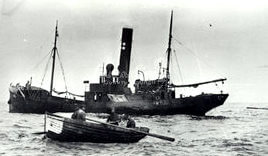
HMT Asia
HMT Asia
(Max depth 70m) The 44 meter long, 309 ton Asia was a Hull trawler leased to the admiralty for anti submarine duties. She struck a mine laid by UC40 on the approach to Lerwick harbour in September 1917 and sank quickly in 70 meters with her stern massively damaged.
SS Slavonic
(Max depth 88m) The ‘Slavonic’ was a Russian, 3604 ton steamer was mined close to the Island of Bressay by UC40 on the 19th October 1917. She sank 30 minutes later under tow. All her crew were saved. Recently more information has come to light casting doubts that this wreck is the Slavonic. A new mystery. What is the identity of this wreck ?….. and where is the Slavonic?
SS Woron
(Max depth 90m) The 3300grt SS Woron (formerly the SS Snowdon Range) was on passage from Archangel, Russia to Lerwick when she was sunk by UC-40 at the southern entrance to Lerwick harbour on October 24th 1917. As yet undived.
DS Anglo Dane
(Max depth 68m) The Anglo Dane weighed 707grt and was 217ft long. In October 1917 she became another victim of UC-40 when she either struck one of the mines laid by the U-boat in Bressay Sound. The wreck now lies in two sections at 68m on a seabed of white sand.
SS Flynderborg
(Max depth 90m) Lost to a mine laid presumably by UC40, on October 21st 1917 this Danish Steamship sank to the South of Bressay island, not far from the Giants Legs.
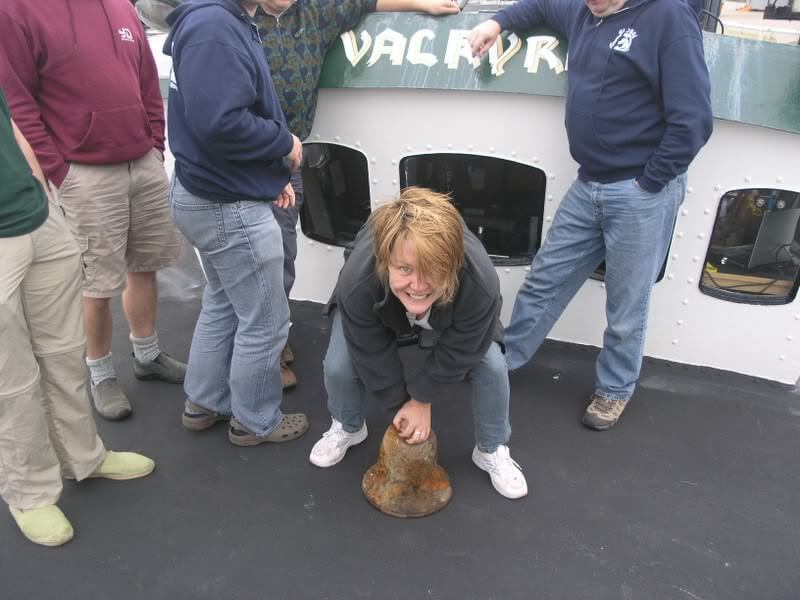
Clare Gledhill with the bell of the Leonatus
SS Leonatus
(Max depth 65m) This collier weighed 2099tons and was en-route into Lerwick harbour in December 1917 when another UC40 mine holed her in the engine room. She now lies in two sections close together and can be dived at any state of tide. The bell from the Leonatus was raised by divers from the Valkyrie in 2009. Bearing the name of “Scarsdale – Stockton” it revealed her first name and port of registry.
MFV Valkyrie
(Max depth 50m) This modern fishing boat hit the rocks of Bressay Island in 1991 and had several attempts at salvage. She now lies at 50m, upright in a small gully with lift bags from one of the salvage attempts floating up from the stern. She makes an excellent dive.
SS Parkmill
(Max depth 68m) This wreck lies in deep water close to the HMT Asia in the approaches to Lerwick. Like the Asia and the other technical dives, the 1300 ton steamship Parkmill was a victim of UC40 which torpedoed her in October 1917. Dived for the first time in June 2011 the Parkmill is a broken but recogniseable wreck in 67m on rocks. the bell was raised on the first dive confirming her identity. Thanks to wreck researcher Kevin Heath for his help in locating this wreck.
FV Parvaim
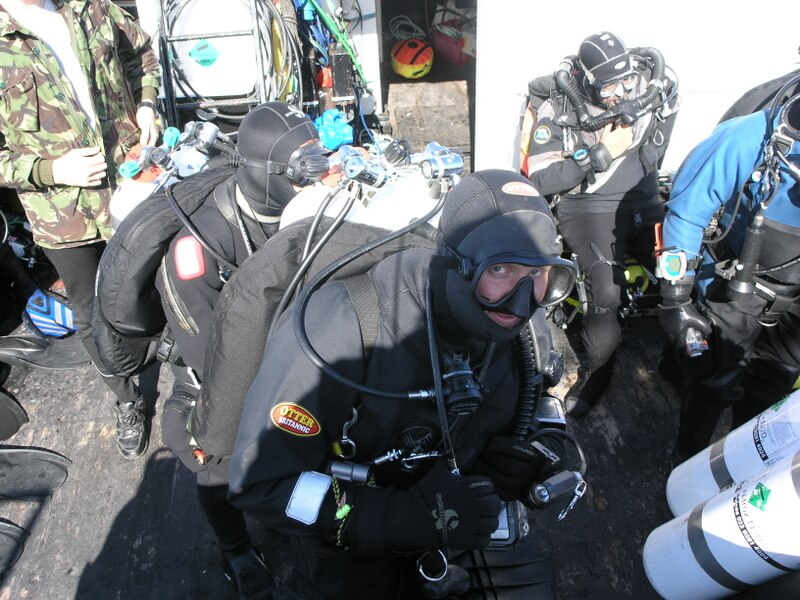
Ready to go!
The Parvaim (BF 403) was a wooden hulled steam drifter 87 GRT, which foundered and sank after being involved in a collision with the Hull registered steam drifter ‘Twenty-Eight’ in July 1907. The wreck was located in July 2011 by the Valkyrie and was dived by Wayne Allen and our very own Helen Hadley to confirm its identity. The boiler, engine, propeller and winches are in 65m of water west of Bard Head.
Coming soon – We are searching for the two halves of a WW1 destroyer lost to the South of Lerwick. Watch this space and our facebook page for details of the hunt and we hope to have great news this year.
