Shetland>Lerwick recreational
Lerwick recreational diving
Lerwick technical scuba dives are also available.
The Place
First of all, where is Shetland? Well, it is a group of islands which make up the most northerly part of the UK which can be reached by ferry or by air. Small islands, voes (an inlet) and spectacular cliffs make up the landscape which is far wilder when compared to Orkney.
See what is going on in Lerwick Harbour!
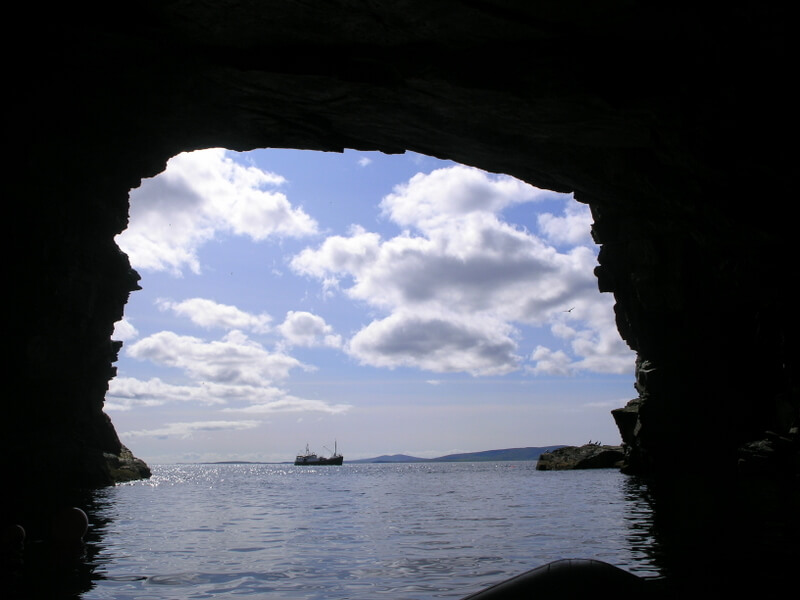
Looking out of the Bard Cave
Dive Shetland
Shetland offers some of the best recreational scuba diving in the UK, with average vis at 10m, with up to 25m being reported on certain dives. Wrecks tend to be more intact the deeper you go, so a firm favourite is the Glenisla at 45m to the seabed. Life on the wrecks is stunning, with lumpsuckers, angler fish, shoals of pollack, butterfish and the occasional conger peering out of a hole enough to keep anyone happy. Nudibranches are also very common on the wrecks, a macro photographers dream! Cetaceans are common here, with Minke, Orca, Risso’s Dolphins, Bottlenose Dolphins, Porpoises and White Sided Dolphins being the most common.
Shetland Charters
Charters run from Sunday to Friday to fit in with the ferries from Aberdeen (arrive 7am Sunday morning, depart 5pm Friday evening).
Some of the Shetland Recreational Dive Sites:
 SS Gwladmena
(Max depth 39m) This 930 ton steamship was sunk in 1918 after a collision with the SS Flora. She lies in Breiwick bay close to Lerwick harbour and is diveable at any state of tide. The wreck lies upright with hull and some deck mostly intact. Lerwick Port Authority has designated this wreck as a protected site.
MV Samba
(Max depth 36m) This small tanker broke down in 1956 and eventually grounded on the Point of Ness close to Lerwick harbour where it broke up. Even the big diesel engines have been reduced to scrap in the shallows but many recognisable pieces make this a great rummage as you ascend the slope from the bow section which lies at 35m. A nice dive for wreckies and fish huggers.

Cooling equipment on the Pionersk (photo by Gareth Lock)
MV Pionersk
(Max depth 22m) This large fish factory ship was grounded in a storm in October 1994 just outside Lerwick. Within a day her back broke and subsequent storms drove her into the rocks. With a least depth of 1m running down to the stern at 22m, this is a big wreck (longer than the Battleships in Scapa) and several dives are needed to get to grips with the whole thing.
Queen of Sweden
(Max depth 18m) The Swedish East Indiaman “Drotningen af Swerige” sank at the mouth of lerwick harbour in January 1745. Cannon, ballast stones anchors and broken glass etc can be seen on the site. A rare chance to dive a historic shipwreck.
MFV Fraoch Ban
(Max depth 32m) This 15m MFV sank due to stability problems in 1999 close to the Isle of Noss. She makes for an interesting dive despite her size and is very photogenic.
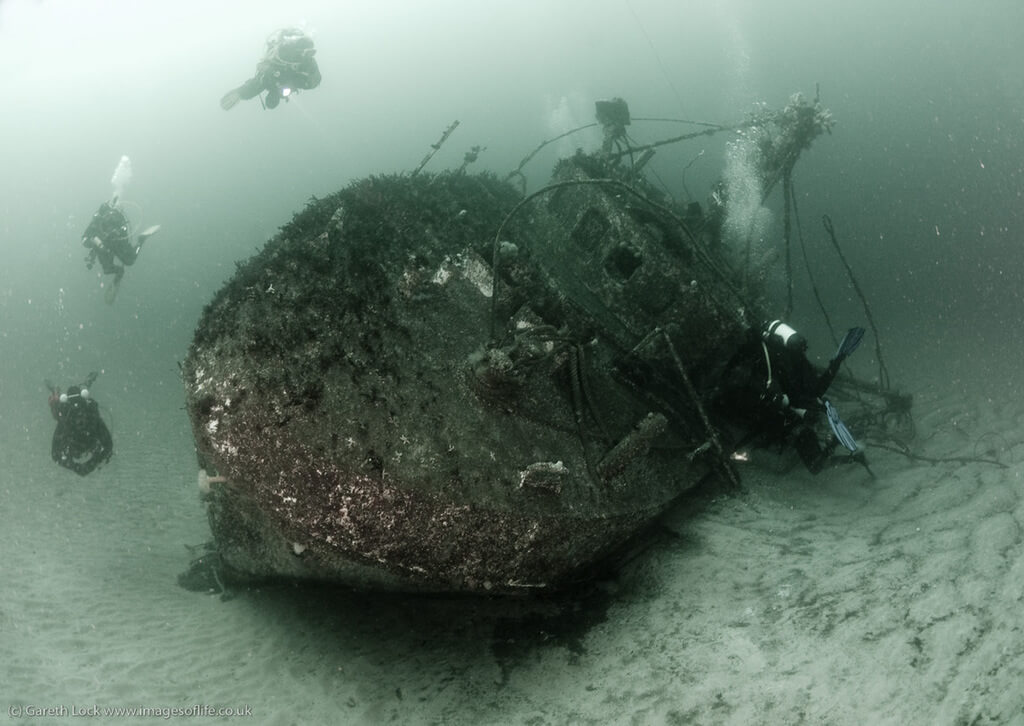
Fraoch Ban (photo by Gareth Lock)
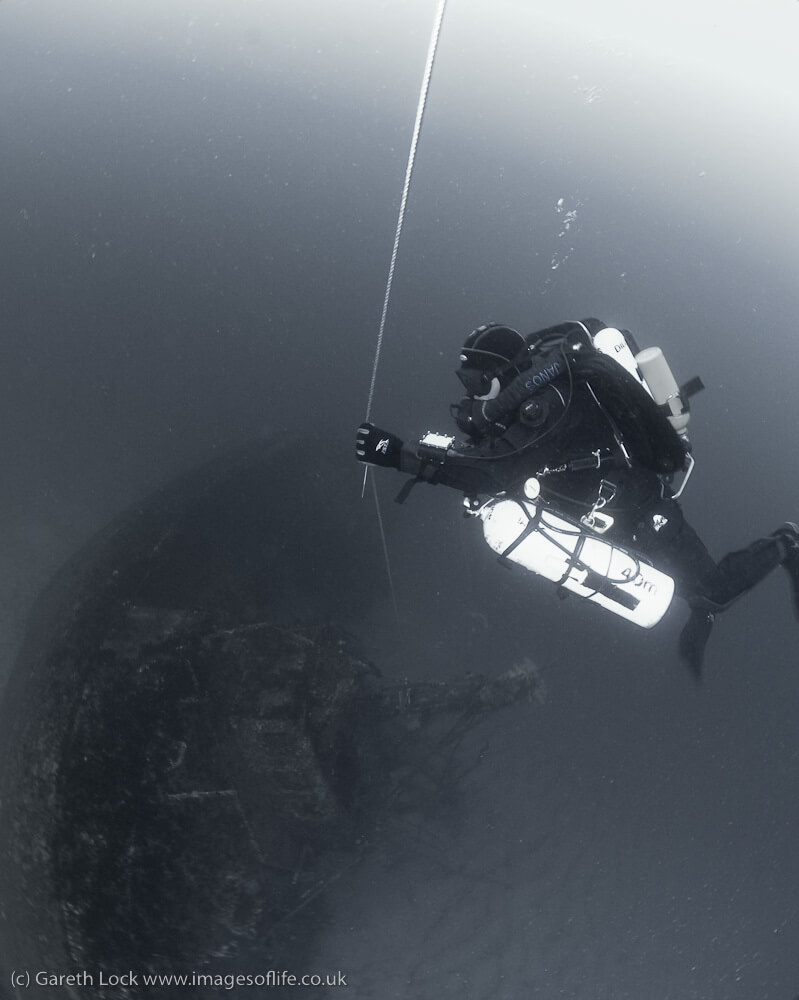
Wreck in the background of the photograph (photo by Gareth Lock)
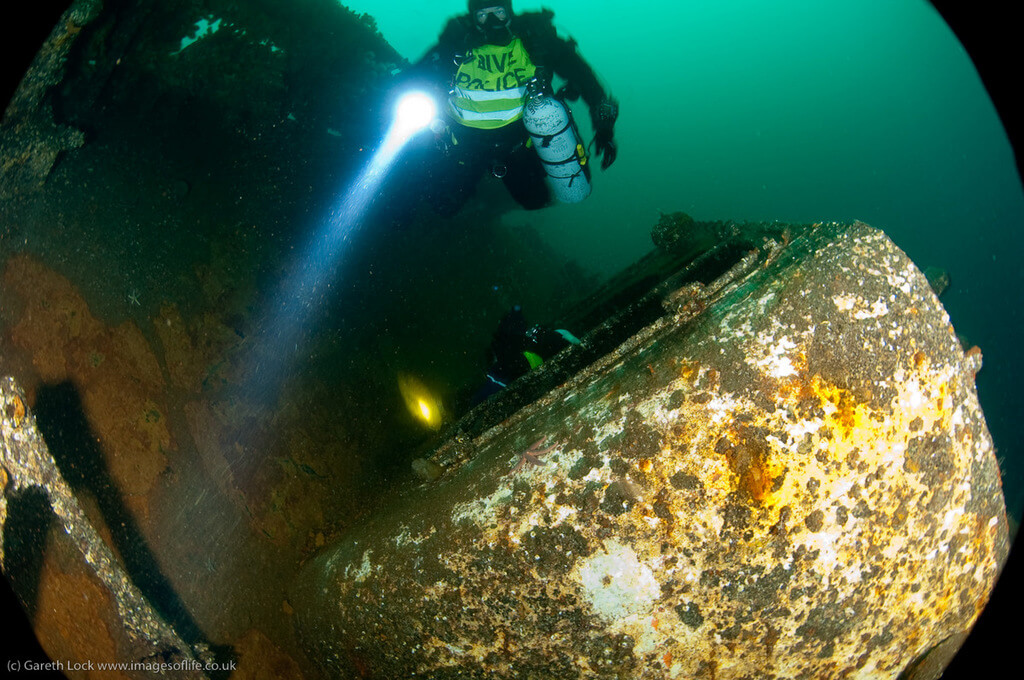
Diver on bow of Lunokhods (photo by Gareth Lock)
MV Lunokhods 1
(Max depth 42m) This Russian fish factory ship grounded in November 1993 just below Kirkabister Lighthouse on Bressay. She sank where she now lies, wedged stern first into the rocks. The stern section is largely intact with a least depth of 2m over it . The midships section ship is progressively more broken as you work deeper until you get to the bow section (about a third of the ship) which lies intact at 42 meters.
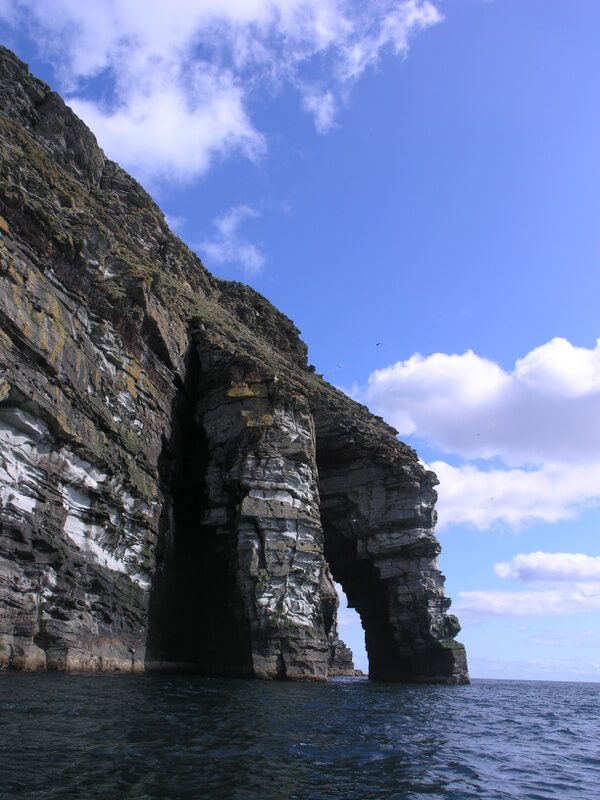
The ‘Giants Legs’ sea stacks
Giants Legs
(Max depth 20m) The Giants Legs are half formed sea stacks. Projecting out from the Bard Head at the Southernmost tip of Bressay Island. This scenic site has a profusion of life on the rock pillars that form the cliff with nudibranchs, anenomes and all manner of fish.
There is also a sizeable cave as part of this formation and a tight almost impassible passage to another cliff face. All in all this has to be one of the most exciting scenic sites in the UK.
H-101
(Max depth 42m) A steel Barge carrying an oilfield installation jacket broke loose in Force 12 winds and grounded on the Bard (next to the Giants Legs) The wreck lies in a maximum depth of 42 meters. Imposing scale characterize this site with the strong tidal currents allowing a profusion of marine life on the shallower parts.
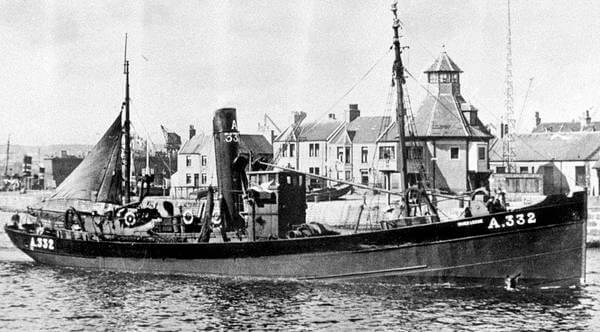
MFV River Lossie
FV River Lossie
(Max depth 20m) This steam trawler ran aground during a blizzard in 1953 near the North mouth of Lerwick harbour. Considered a hazard to navigation she was explosively dispersed in 1954. In shallow water the wreck affords a small sheltered site that can be dived in all but the worst weather.
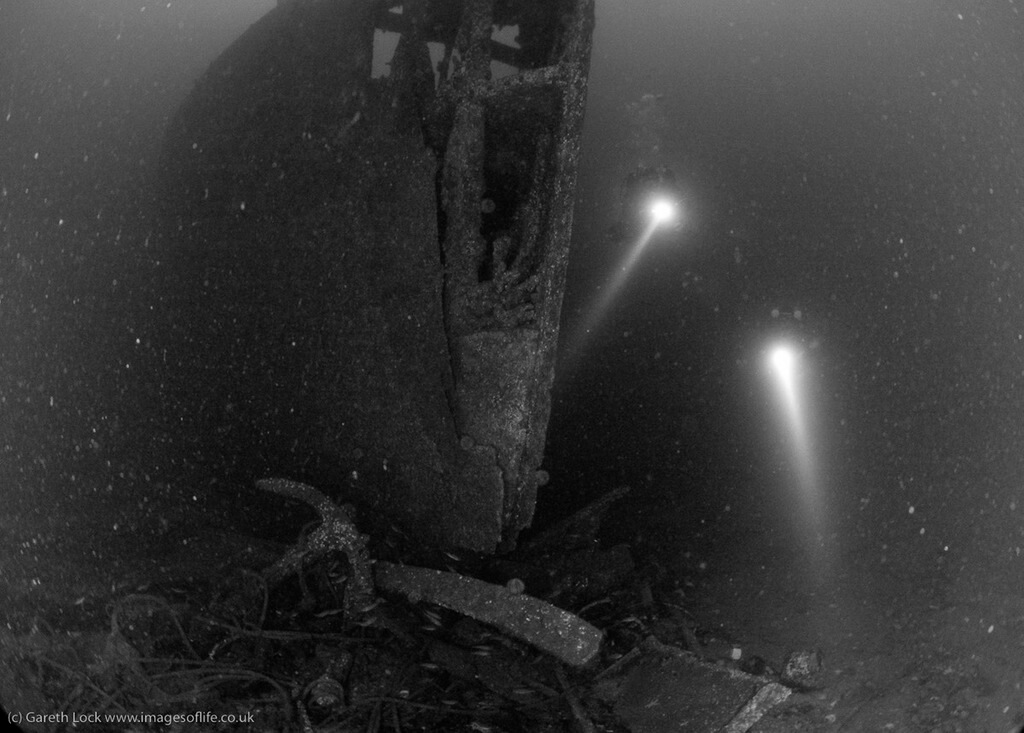
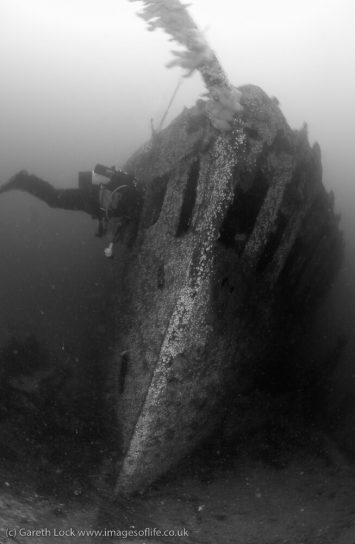
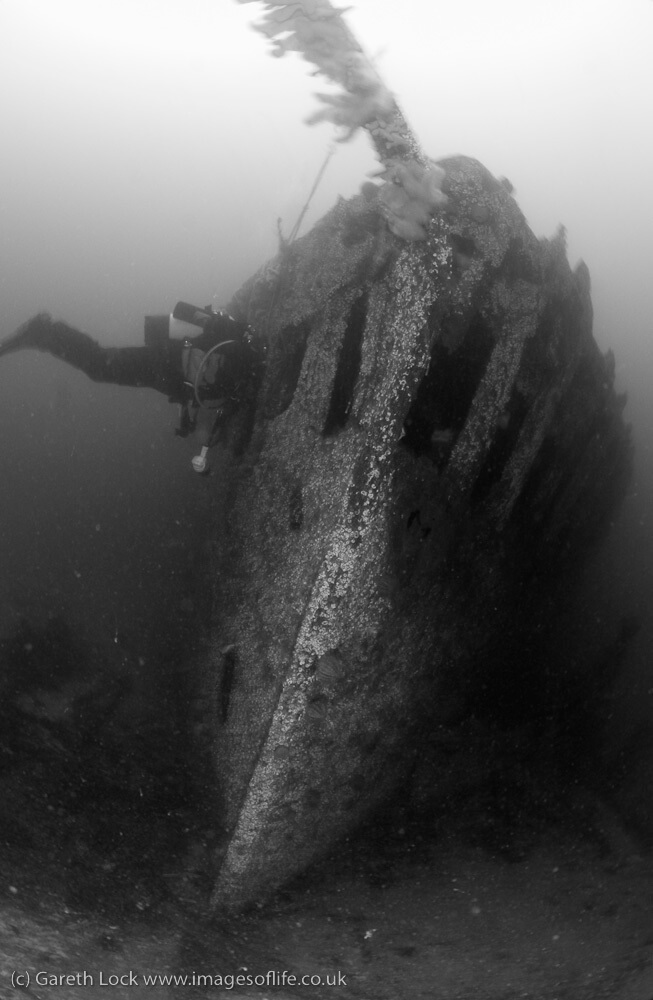
Bow of the Glenisla (photo by Gareth Lock)
SS Glenisla
(Max depth 45m) this 1423 ton steamer, was involved in a collision with the SS Glenelg and sank in the middle of Bressay Sound in the shipping channel. She now lies in 45m of water, upright and largely intact, with her bows facing North and is one of the best dives of the type in the UK . Lerwick Port Authority has designated this wreck as a protected site.
MV Borodinskoye Poleye
(Max depth 25m) In November 1993, the Borodinskoye Poleye a Russian “Klondyker” fish factory ship, struck a rock near the north mouth of Lerwick Harbour.
This wreck is very broken up and divers from the Valkyrie started to explore this large confusing site in 2008. The sections of the hull range in depth and the engines are still to be found.
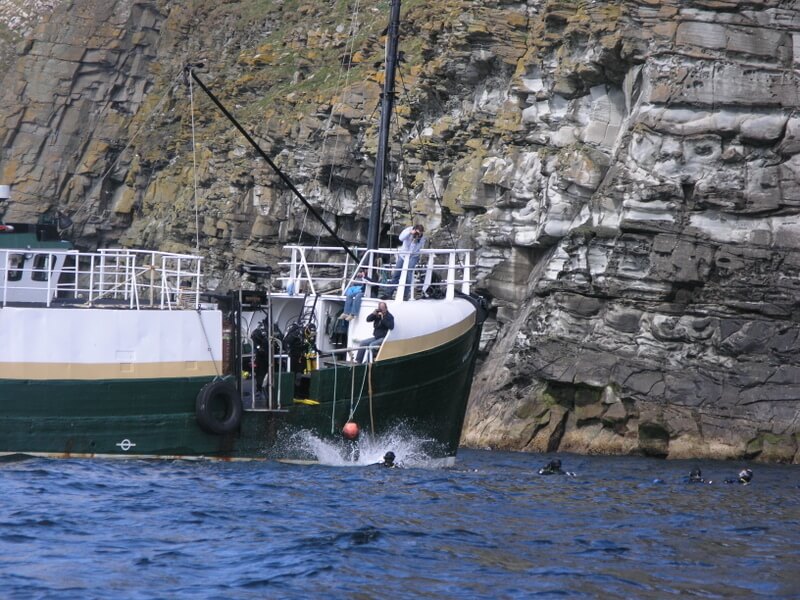
Entering the water for a high energy wall dive.
Noss Head
Comparable to St Abbs in terms of the sea bottom, this dive is a real treat. Only accessable when the conditions allow, you are dropped close to the immense gannet colony on Noss. The incredibly high level of nutrients (I will leave it to your imagination where they come from!) means that life is prolific, with the massive boulders and gullies packed full of dead mens fingers, anglerfish, lumpsuckers, wrasse, pollack, nudibranches and even the occasional octopus.
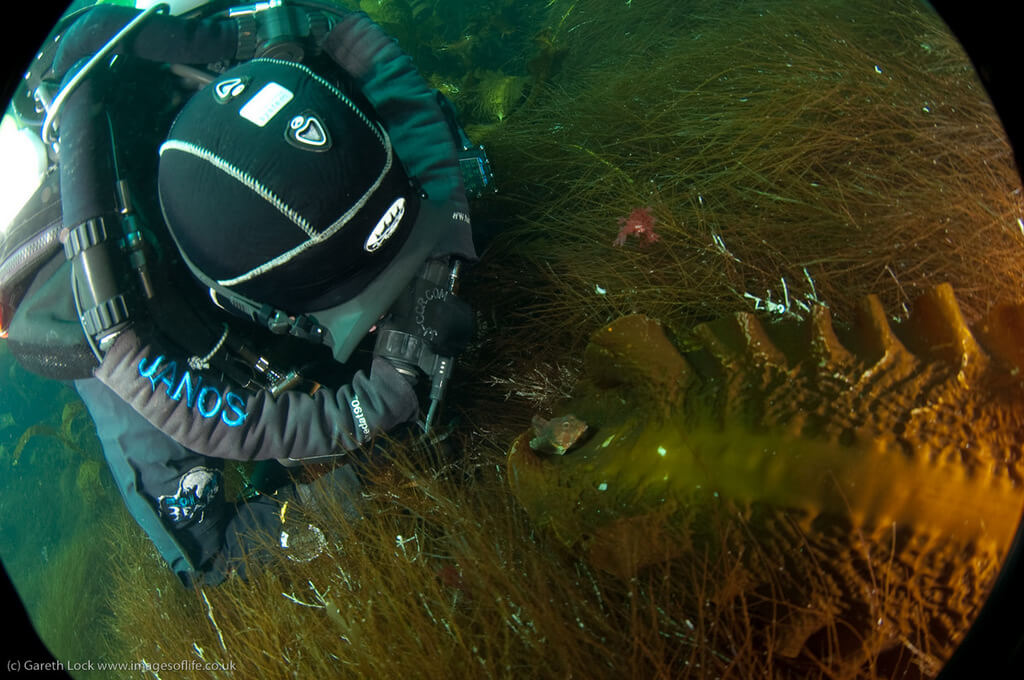
Janos getting up close and personal with the wildlife (photo by Gareth Lock
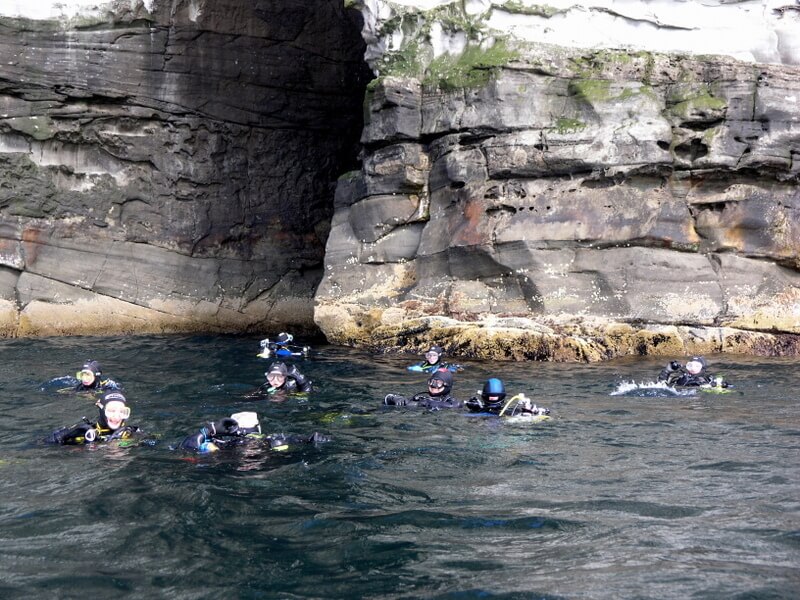
The Bard Cave
This huge natual opening is very close to the Giants Legs on the island of Bressay. So large that a local tourist boat actually moors up inside the cave, there is always air above you and daylight is always visible – so technically not a true cave dive. However, it does offer a unique environment for flora and fauna, with a very paranoid seal usually resident at the back of the cave. The floor is washed by the powerful southerly swells, so all life tends to be the smaller things – anemones, dead mens fingers, nudibranches, all of which love this high energy site.
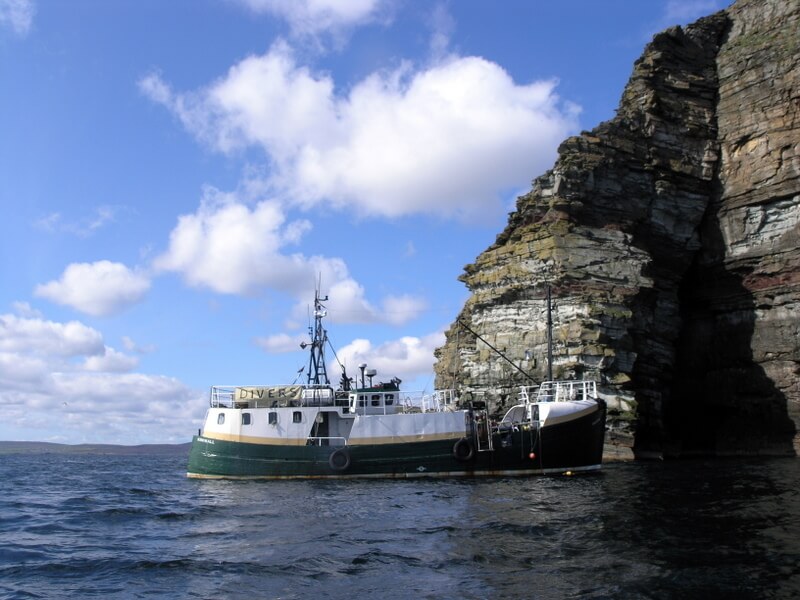
The Valkyrie at the Giants Legs
Longwi Cave
This is a terrific dive in a cave system with three smaller caverns meeting in a cathedral like central cave. Its shallow depth makes it great photography and it is full of life. Octopus are regularly seen here as are seals and shoaling fish.

JU88 A6-BH
JU88 D-1 A6-BH
In 2014 we were very lucky to find the remains of Junkers 88 D-1 just to the North of Lerwick harbour. Our thanks go to Kevin Heath and Dave Earl for their help in identifying this aircraft.
Here is the media article of the story:
Orkney divers on an expedition to the isles discovered one of the engines from the Junkers 88 D-1, which was hit by anti-aircraft gunners while on a long-range reconnaissance mission over the Northern Isles on 5th March 1944.
Historical accounts say the bomber was badly damaged and had to ditch close to the North end of Bressay.
Radio operator Unteroffizier Anton Reisch, observer OberLeutenant Alfred Cardaun and the pilot Feldwebel Marggraf managed to escape the sinking aircraft and swam, unwounded, to shore on the Holm of Beosetter.
However, the gunner, Unteroffizier Bruno Lindner was either killed in the crash or did not escape the bomber in time and died.
The three survivors were recovered by an air/sea rescue launch from Lerwick and were questioned by RAF intelligence before being interred as prisoners of war.
Now, divers aboard the Orkney-based dive boat Valkyrie believe they have uncovered parts of the plane’s wreckage. Their discovery of an engine in July was followed by the finding of further parts in subsequent dives.

JU88 A6-BH
They say the engine, a V12 Jumo aero power-plant, was found in about 12 metres of water. Sections of the aluminium skin and some parts of the aircraft frame are said to lie deeper in almost 30 metres.
The aircraft is presumed to have broken up on impact and this, combined with the action of the waves in the shallow waters and dredging operations, could have further dispersed the wreckage over a wide area. Further dives are planned over the next year and more parts of the aircraft including the second engine and undercarriage are expected to be found.
Orkney-based aircraft crash researchers Kevin Heath and Dave Earl undertook the work to identify the crashed aircraft and its crew.
Many parts of his research are undertaken through “ARGOS” (Aircraft Research Group Orkney and Shetland) of which Mr Earl is also a member and researcher.
The exact position of the JU88 has not been disclosed. However, it is understood the approximate location will be released to provide some information to any living relatives of the lost airman.
